
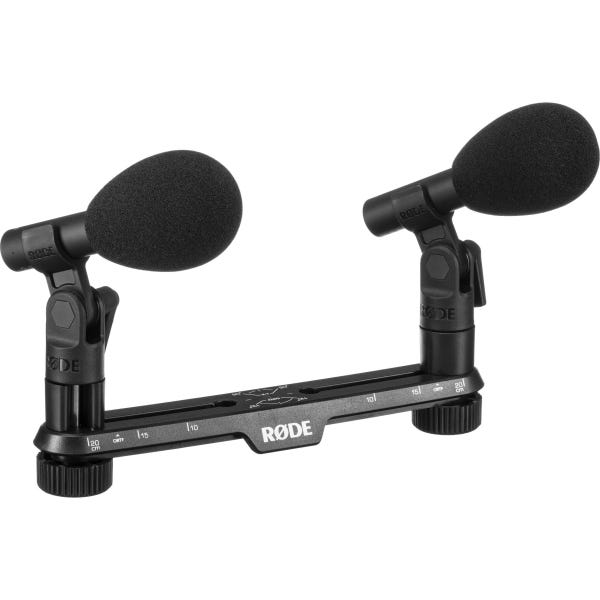
Precision-Matched Pair of Small-Diaphragm Condenser Microphones, Tight Cardioid Polar Pattern, Externally Biased True Condenser Capsule, Ultra-Low 14 dBA Self-Noise, 135 dB SPL Handling, 30 Hz-20 kHz Response, Designed With Tony Faulkner, Complete Stereo Kit With Stereo Bar, Clips, and Windshields
All RØDE products are warranted for one year from date of purchase. If you purchased your microphone from us then you may be able to extend your warranty to two years, five years, ten years or lifetime (depending on the model) by registering the details of your purchase with Rode.
The Rode TF-5 is a precision-matched pair of small-diaphragm cardioid condenser microphones built for the most demanding acoustic and orchestral recording, offered as a stereo set with capsules matched to sub-micron tolerances. What sets it apart from an ordinary "pencil" condenser is its voice: it keeps the airy top-end clarity and pinpoint detail small-diaphragm mics are famous for, but adds a warm, natural body that this class of microphone usually lacks. Voiced in collaboration with Grammy-winning classical engineer Tony Faulkner, the TF-5 is the microphone you reach for when the recording has to be faithful, dimensional, and beautiful all at once.
A small-diaphragm condenser uses a lighter, smaller membrane than a large-diaphragm studio mic, and that physical difference is the whole point. A lighter diaphragm can start and stop moving faster, so it tracks fast transients -- the pluck of a string, the strike of a mallet, the leading edge of a bowed note -- with speed and accuracy that a heavier large diaphragm rounds off. It also produces a more consistent, predictable polar pattern across the frequency range, which is why small-diaphragm mics are the standard for orchestral, acoustic, and stereo work where an honest, uncolored picture of the source matters more than flattering thickness. The TF-5 delivers that textbook accuracy, then adds the warmth that keeps accurate from ever sounding clinical.
Recording in stereo only works if the two microphones hear the world identically. If one capsule is even slightly more sensitive or has a subtly different frequency response, the stereo image drifts, the center wanders, and the recording collapses toward one side when summed to mono. A matched pair solves this at the source: the two TF-5 capsules are manufactured to sub-micron tolerances and selected so their sensitivity and response track together, so left and right are true mirror images of each other. The result is a stable, believable stereo picture -- instruments sit exactly where they were in the room, the center is rock solid, and the recording stays coherent whether it is heard in stereo or folded to mono.
The TF-5 uses a tight cardioid polar pattern, meaning it is most sensitive to sound arriving from directly in front and progressively rejects sound from the sides and rear. In practical terms, that lets you point the microphone at what you want and turn down what you do not: the ring of the room, the bleed from a neighboring instrument, the reflection off a hard wall. On a stereo pair this control is what makes spaced and coincident techniques work, letting you dial in exactly how much room you capture by how you angle the two mics. On a single instrument used as a spot mic, the pattern isolates one voice within a larger ensemble so it can be lifted cleanly in the mix.
Two specifications define how much a microphone can handle, and the TF-5 is generous at both ends. Its self-noise sits at just 14 dBA, low enough that the microphone itself stays silent behind the quietest passages -- a decaying cymbal, a softly bowed cello, a fingerpicked guitar in a still room -- so the recording captures the performance rather than a hiss floor. At the other extreme it handles a maximum SPL of 135 dB, so the same microphone can sit close to a snare drum, a brass section, or a loud acoustic without distorting. Combined with a high 35 mV/Pa sensitivity and a 30 Hz to 20 kHz response, that wide dynamic window is what lets one pair of microphones cover everything from a whisper-quiet ensemble to a full, loud room.
The TF-5 carries the fingerprints of Tony Faulkner, one of the most respected classical recording engineers in the world, whose decades of orchestral and acoustic work informed how this microphone is voiced. That collaboration is why the TF-5 does not simply chase a flat measurement -- it is tuned to sound right on real instruments in real rooms, with the balance of accuracy and warmth that classical engineers prize. When a microphone is developed alongside someone who has spent a career capturing orchestras, the result is a tool that behaves musically the moment you put it up, rather than one that needs corrective EQ to sound natural.
As a matched pair the TF-5 is a natural for stereo work: spaced-pair or coincident orchestral recording, drum overheads that keep the kit's image intact, piano captured in full width, choirs, string ensembles, and room ambience. Used singly, each microphone is an excellent spot or close mic for acoustic guitar, strings, woodwinds, percussion, and hand drums, where its transient speed and low noise print every detail. This is the pair for the classical or acoustic engineer, the studio building a serious overhead and room-mic locker, and the recordist who wants a reference-grade stereo set that sounds warm as well as accurate. It ships as a complete stereo kit -- two microphones, the Rode Stereo Bar, mic clips, and windshields -- so it is ready to record the moment it arrives.
| MPN | TF5MP |
|---|---|
| Color | Black |
| Element | Condenser |
| UPC / EAN | 698813005345 |
| Brand | Rode |
| Product Condition | New |
| Availability | Out of Stock |
| Type | Small-Diaphragm Externally Biased (True) Condenser |
| Configuration | Precision-matched stereo pair |
| Polar Pattern | Cardioid |
| Active Electronics | JFET impedance converter with bipolar output buffer |
| Frequency Response | 30 Hz - 20 kHz (±3 dB); 20 Hz - 20 kHz (±4 dB) |
| Sensitivity | 35 mV/Pa (-29 dB re 1V/Pa) |
| Self-Noise | 14 dBA |
| Maximum SPL | 135 dB (1 kHz @ 1% THD) |
| Output | Balanced 3-pin XLR |
| Power | 48V phantom power (P48) |